
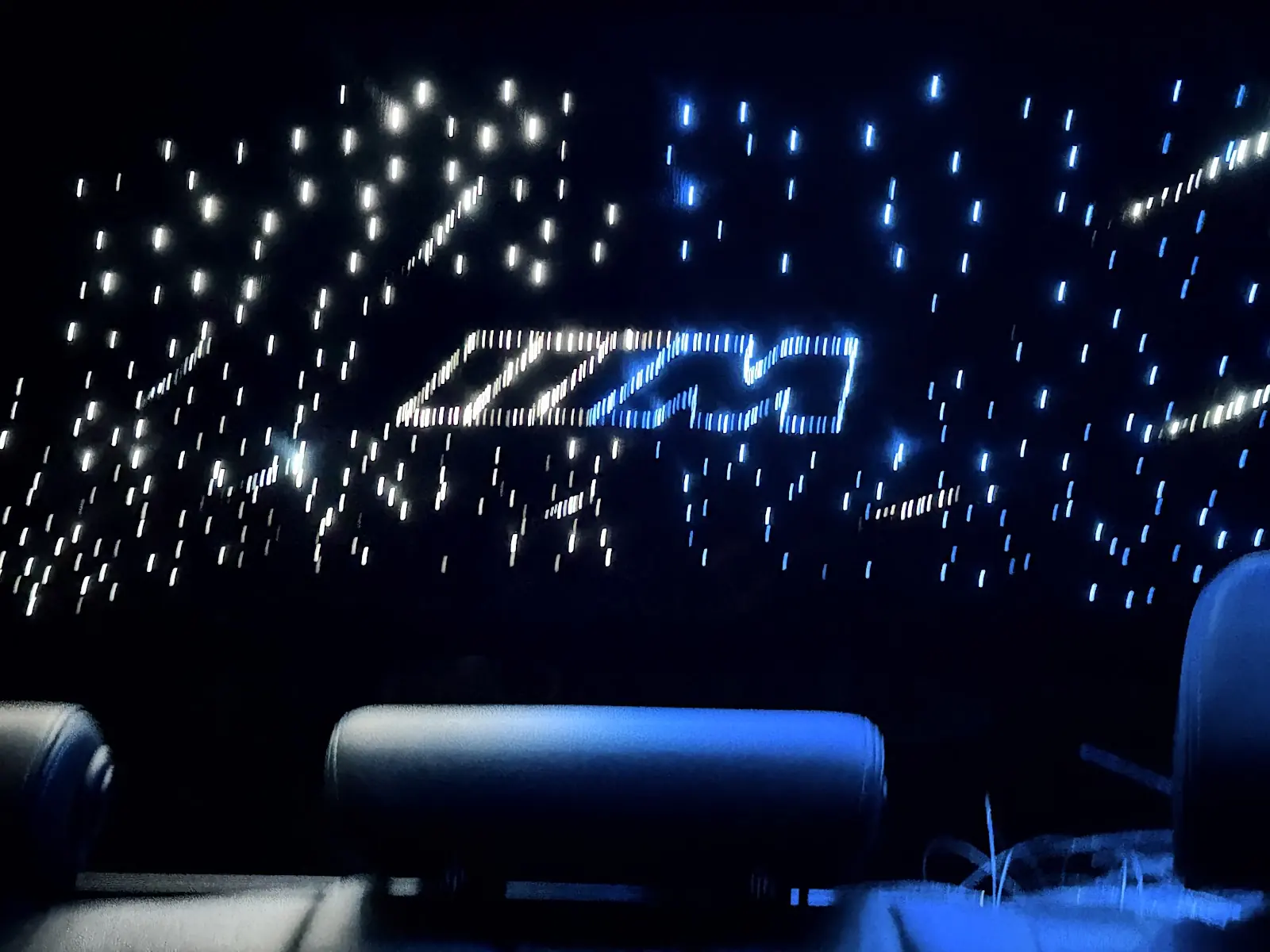
Starlight headliners, built one fiber at a time.
Rolls-Royce made the idea famous. We fit it to whatever you drive — two hundred stars or eight hundred, plotted or scattered, wired to a switch you already use. Every point placed and heat-set by hand on our bench in Danbury.


Pick the density before we drill a hole.
A factory headliner is a flat grey lid. The same board, stripped and rebuilt, is the reason you take the long way home. Drag the slider — whatever you stop on is what we build.
Most owners land between 200 and 400. Below 150 a roof reads as sparse. Past 600 the points stop registering and it reads as static.
How a starlight headliner is actually built
Most of this job is invisible by the time you sit in the car. That is exactly why it is worth reading before you hand your roof to anyone.
The panel comes out whole
A headliner is one moulded board — pressed fiber or fiberglass, with foam-backed cloth bonded to its face. To get it out, the pillar trims, grab handles, visors, dome light, and mouldings come off, and on plenty of cars the seats or the rear glass have to move before the board will clear the door aperture. None of this stage is glamorous. It is also where most of the damage happens, so we go slow. A board creased on the way out reads as creased forever, no matter how good the fabric you put over it.
The old fabric comes off, and so does the foam
Under the cloth is a layer of foam. On an older car that foam has already turned to orange dust in your fingers. That is what a sagging headliner really is — foam failing, not glue failing. All of it gets stripped back to bare board and scrubbed clean, because fiber ends need to sit against something solid, and new fabric bonded over dead foam will fail again on the same schedule.
Every fiber is placed by hand, from the back
Each star is a hole. Each hole takes one strand of end-glow PMMA fiber, fed through from the reverse and glued off behind. We run mixed diameters — roughly three-quarters of a millimetre up to a millimetre and a half — and that choice does more work than the star count does.
Here is why. Uniform points look like a ceiling with holes in it. Varying the fiber diameter varies the apparent brightness of each point, and apparent brightness is what your eye reads as distance. That is the whole trick. Four hundred identical stars are a perforated board. Two hundred and fifty in a considered mix are a sky with depth in it.
If you want a real constellation — an actual sky over a date, a place, a hemisphere — that gets plotted on the board before a single hole is drilled. You cannot back into it later.
Heat-setting is what makes a star a star
Trimmed flush, a fiber end is a needle: hard, narrow, faintly clinical. So each one is left proud of the fabric and then briefly heated until the tip mushrooms into a small dome. Two things happen at once. The dome cannot pull back through the fabric, which is the mechanical half. And the dome widens the emission cone, which is the half you actually see — the point stops being a pinprick and picks up a soft halo, the way a star does.
Hundreds of them, one at a time, each one trimmed and set individually. This is the slow part of the job. There is no version of it that goes faster, and a shop that finished your roof in an afternoon skipped it.
The engine sits somewhere else entirely
The fibers gather into a ferrule and run to an RGBW LED engine mounted in a trim void — behind a quarter panel, under a seat, wherever there is air and access. Nothing electrical goes into the ceiling at all. The fiber carries light, not current and not heat, which is why you can lay your hand flat on a running starlight headliner and feel exactly nothing.
Twinkle comes from the engine, either from a rotating wheel that chops the beam or from an electronic driver. Shooting stars are a separate run of fibers on their own sequenced channels, fired in a chase across the roof. Colour and speed run off a remote or an app, depending on the engine we spec.
Where the bundles run matters more than anyone tells you
Most cars built this century have curtain airbags in the roof rails — the ones that drop down over the side glass. A fiber bundle routed through that path is a bundle sitting in front of a pyrotechnic device. We route around them, every time. We keep the loom clear of seat rails and off anything that moves or folds. This is the part of the job nobody photographs, and it is the part we would walk away from a booking over.
Re-wrapping, and the drying nobody has patience for
New foam-backed fabric goes on: factory-match cloth, suede, or Alcantara if you want the ceiling to answer the rest of the leather interior rather than argue with it. It is bonded with high-temperature contact adhesive, not the general-purpose spray sold at the parts counter. The roof of a car parked in a Danbury lot in July gets hot enough to soften ordinary glue, and a headliner that lets go at the corners is a job you paid for twice.
Adhesive has to flash off before the two faces touch, and the board has to cure before it goes back in the car. That waiting is not us being slow. It is the difference between a ceiling still tight in five years and one that becomes a lesson.
Wired to something that turns off
The engine feeds from a switched accessory circuit at the interior fuse box, on its own inline fuse, through a fuse tap rather than a cut into the harness. Key off, stars off, and the battery is still there on Monday. We do not splice into airbag, ABS, or any circuit the car uses to decide something important. The entire loom comes back out without a trace, which matters more than people expect at trade-in.
If you are already thinking past the roof, the same bench does footwell, door and dash ambient LED and custom headlight and taillight work. Doing them in one visit means one loom, one fuse plan, and one set of panels off the car.
Four steps, no surprises
Consult
Send photos of the roof or bring the car by. Year, make, model, star count, material. You get one fixed number before anything comes apart.
Design
Density, fiber mix, constellation or scatter, shooting stars, control method, where the engine lives. You approve a plan, not a vague idea.
Build
Board out, foam stripped, every fiber placed and heat-set by hand, panel re-wrapped, bundles routed clear of the airbags, engine on a switched source.
Reveal
We hand it back after dark. That is not showmanship. It is the only honest way to look at a night sky.
What moves the number
We will not print a price on a website, because a price given before we know your car is a guess wearing a suit. Here is what the figure is actually made of.
- Star count. The biggest lever, and not a linear one. Every star is a hole, a fiber, a glue-off, and a heat-set. Four hundred is not twice the work of two hundred — it is twice the work plus the layout that stops four hundred from reading as noise.
- Roof area. An SUV ceiling is a great deal more board than a coupe’s, and every extra square foot is more fiber and more wrapping.
- Panoramic glass. It cuts the canvas down and adds difficulty. Less room to work, a cassette to route around, and fiber paths that have to find a way the sunroof does not already use.
- Shooting stars. Separate channels, separate routing, a controller that has to be told what to do and when.
- Material. Factory-match cloth is the floor. Suede is a step up. Alcantara or leather sits at the top and changes how the whole panel has to be handled.
- A plotted sky. Random scatter is one job. An accurate constellation, a specific date, a horizon line — that is drafting before it is drilling.
- Control method. A remote in the glovebox is simple. App control is a module. Tying the stars into a switch the car already has is the most work and the least visible, which is usually the sign it was worth doing.
- What the roof was like when it arrived. Every board gets stripped either way, but one that has been glued and re-glued twice already is a longer prep than one that is merely old.
- How the car comes apart. Some roofs surrender in an hour. Some need the seats out and the rear glass out first, and that is time before the real work starts.
You get one fixed figure before we touch the car. If we open the roof and find something we did not expect, you hear about it before we act on it — not on the invoice afterwards.
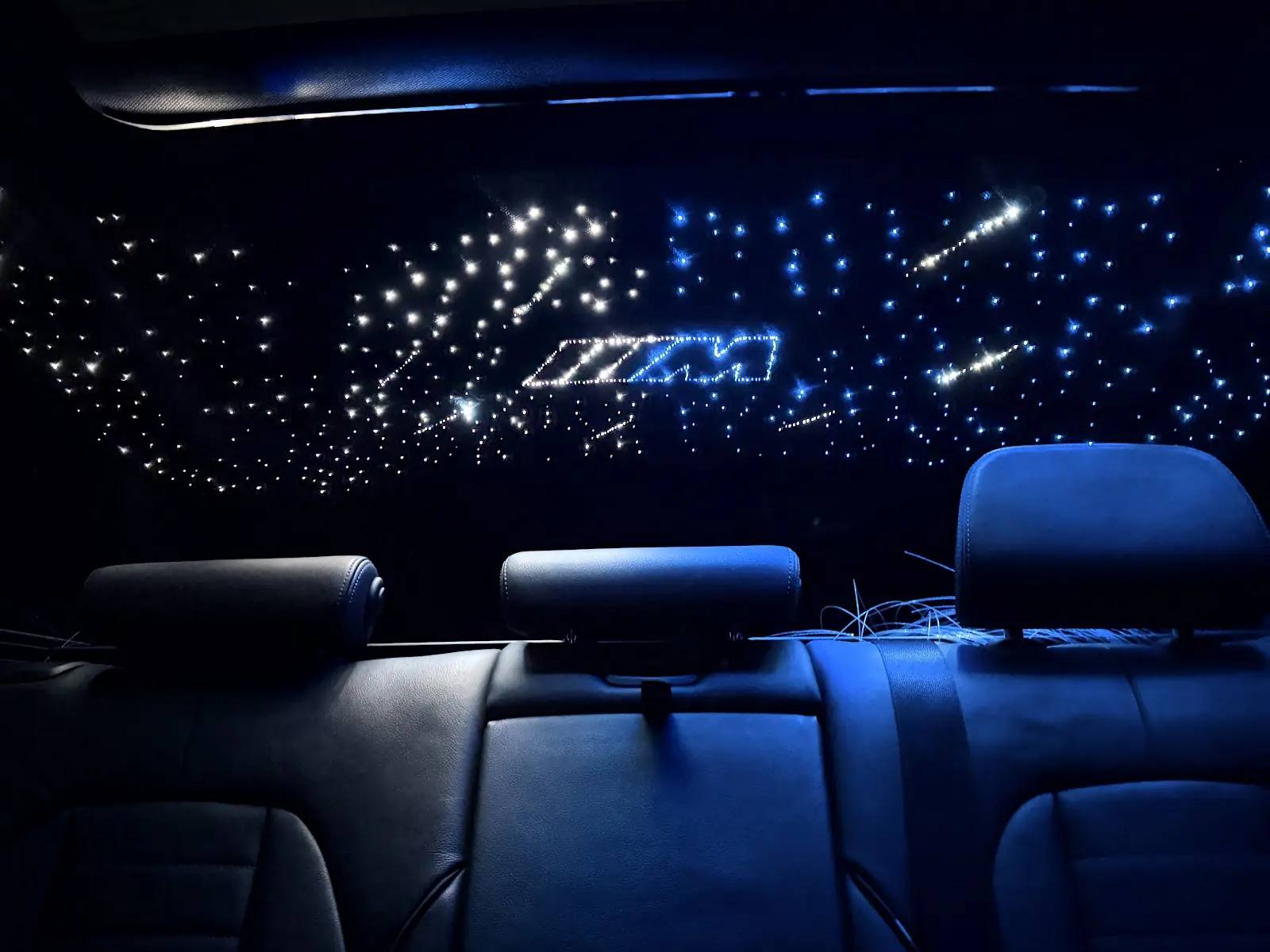
Built here. Photographed here.
No stock imagery and no borrowed builds — every roof below left our bay in Danbury.


Starlight headliner questions
It is driven by star count, roof area, material, and how hard the car is to take apart. A compact coupe with a modest count and factory-match cloth sits at the entry of our range. A full SUV roof with shooting stars, Alcantara, and app control sits at the top. We do not quote a number until we know the year, make, and model, because a number given before that is a guess dressed up as a price. What you get is one fixed figure before anything comes apart, and no hourly drift after.
Most cars are with us two to four days. The panel comes out, the old fabric and dead foam are stripped back to bare board, every fiber is placed and heat-set by hand, the panel is re-wrapped, and the engine is wired to a switched source. The stage we will not compress is drying. Contact adhesive has to flash off before the faces touch, and the board has to cure before it goes back in the car. Rushing that is exactly how a headliner ends up sagging inside a year.
Most owners land between 200 and 400. Under about 150 the roof reads as sparse rather than deliberate. Past roughly 600 the individual points stop registering and it starts to read as static instead of sky. The number matters less than the spread of fiber diameters. Four hundred uniform points look like a perforated board. Two hundred and fifty in mixed sizes look like distance. Drag the slider on this page and pick the density you actually want, then we build that.
In the United States the Magnuson–Moss Warranty Act means a dealer cannot void your entire warranty over an aftermarket part. They can decline a claim on a component our work directly caused to fail. We wire to a switched accessory circuit through the interior fuse box on its own inline fuse, using a fuse tap rather than a cut into the harness, and we never splice into airbag, ABS, or any circuit the car uses to decide something important. The loom comes back out without a trace. That keeps the exposure contained to the headliner itself.
Yes, and they look better than people expect. The glass takes canvas away, so you are working the perimeter rather than the whole ceiling, and the fiber runs have to find a path the sunroof cassette does not already use. It is more work in less space. What you get back is a band of sky framing the glass, which some owners prefer to a full roof. Send us the year, make, and model and we will tell you honestly what your roof will take.
No heat, ever. The fiber carries light, not current, and the LED engine sits remotely in a trim void with air around it, so you can put your hand flat on a running headliner and feel nothing. Sagging is a foam and adhesive problem, not a fiber problem, which is why we strip the old foam back to bare board and re-wrap with high-temperature contact adhesive instead of the general-purpose spray sold at the parts counter. A quality engine is rated well past 30,000 hours of use, which is longer than most owners keep the car.
Tell us the car. We’ll tell you what the roof will take.
Send a couple of photos of the ceiling and the year, make, and model. You get a fixed number back — usually within one business day, always before anything comes apart.