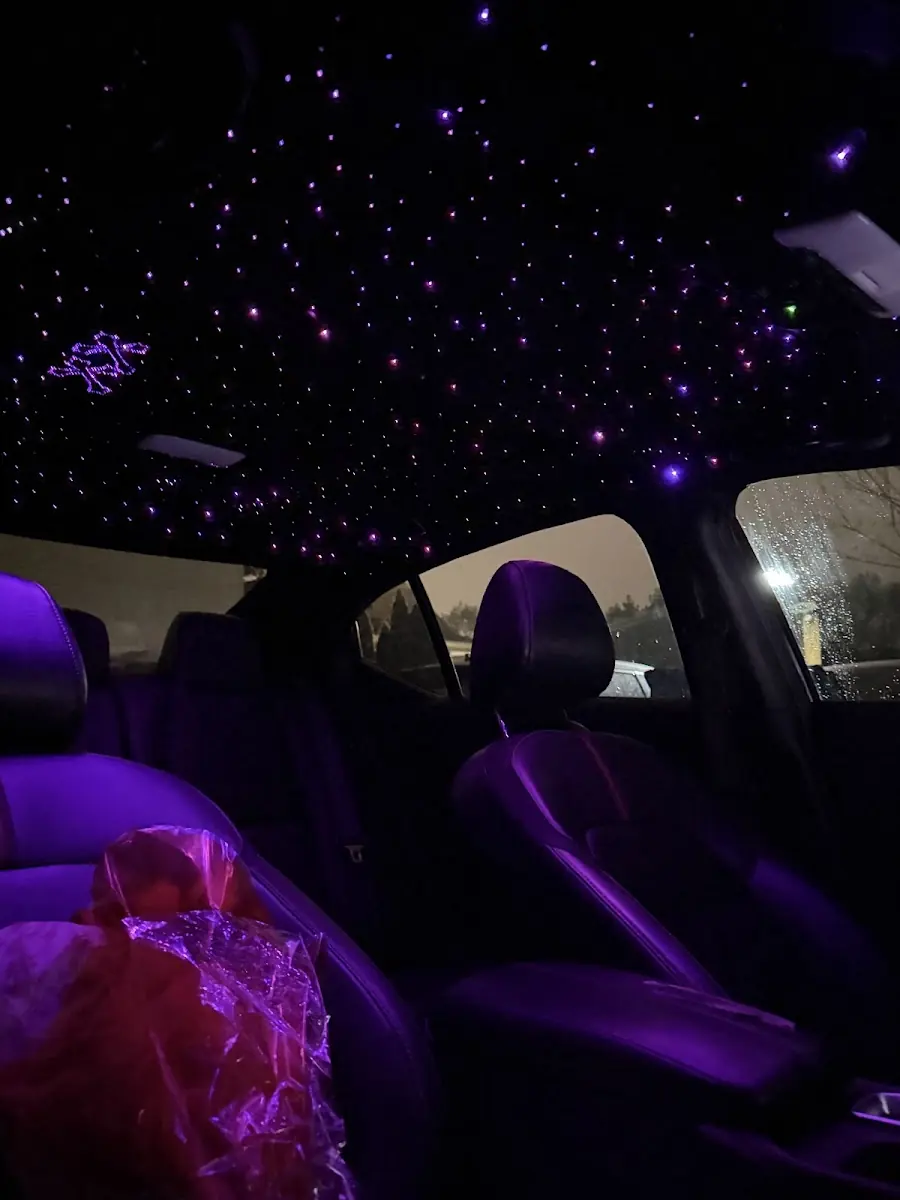
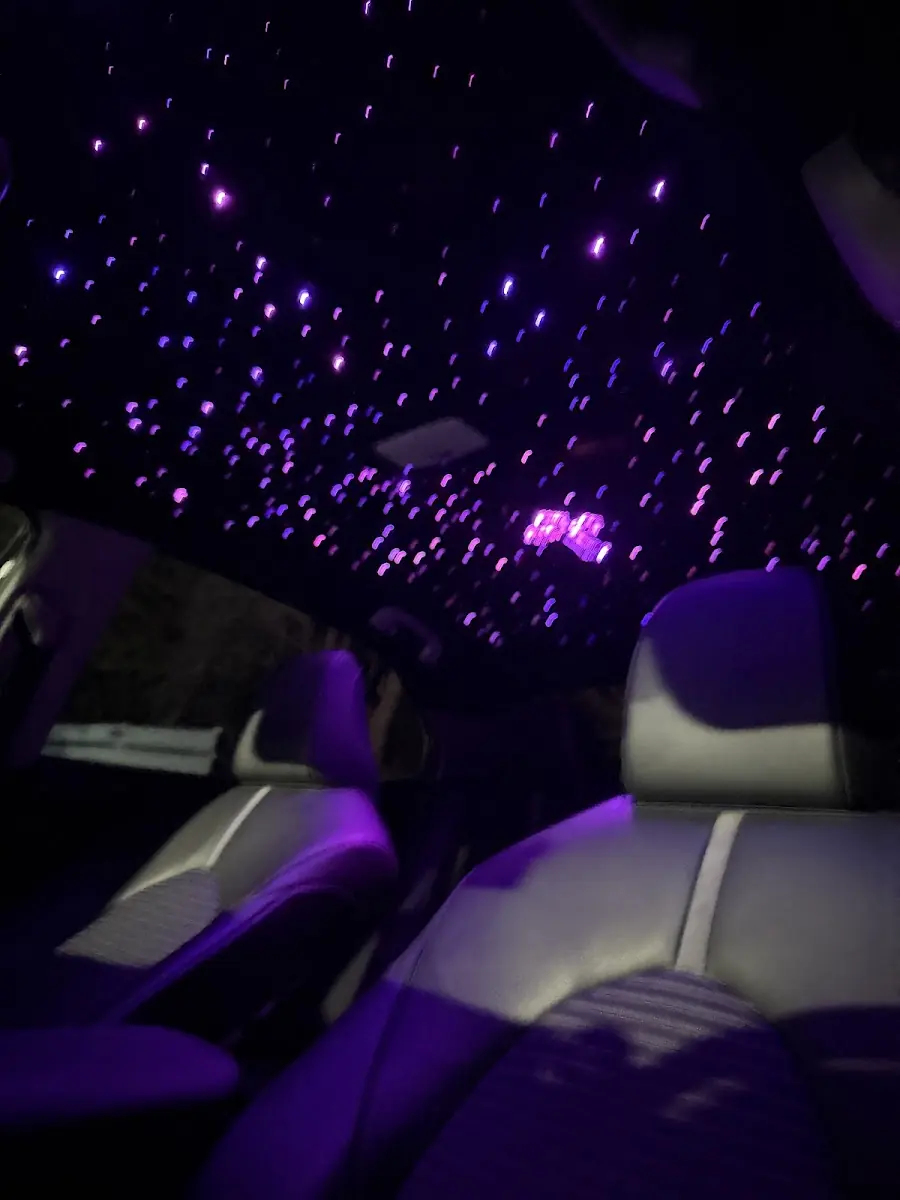
Ambient Lighting · Danbury, CT

Wired in like it came that way.

Footwells, door cards, dash inlays, consoles. Multi-color LED that fades with your dash, answers to your phone or the factory screen, and never shows you the diode that made it.

Where the light goes

Six zones. One coherent glow.

Good ambient lighting is aimed at surfaces, never at eyes. You should see leather, trim, and carpet come up out of the dark — not a row of bright dots reflecting in the glass.

Footwells

The zone everyone starts with, and the one most often done badly. The emitter hides under the dash lip and the seat rail, throwing light down and forward across the carpet so the wash appears without a visible source. Get the angle wrong and you light the driver's shins, dazzle the mirror, and give the passenger a headache on a long run. We set the aim with the trim back in and the doors closed, at night, in the dark — which is the only condition the work will ever actually be judged in.

Door cards

A diffused line following the trim break, or fibre laid into a routed channel. It reads as a lit edge, not as a strip stuck to a panel.

Dash inlays

Backlit trim strips and lit seams across the fascia. Kept below the level where anything reflects back off the windscreen.

Cupholders & console

Rings, shifter surrounds, and storage wells. Small zones, and the ones your hands find every day without looking.

Boot & trunk

Even white light across the whole load floor instead of one dome bulb in a corner. The least glamorous zone and the most used.

Seat backs

Rear footwell light thrown from the front seat backs. Worth doing on anything that carries passengers who are not you.

Control & wiring

How it is switched, and what is behind the trim

Anyone can stick a strip in a footwell. The difference between an install and a kit is entirely in the two things you cannot see: how it is controlled, and how it is wired.

App control, and its failure mode

Nearly every app-controlled LED kit is a Bluetooth controller hidden behind a trim panel with a phone app in front of it. The lighting is rarely the problem. The app is. A controller from a brand that folds takes its app down with it, and you are left with a colour you cannot change and a module you cannot reach without pulling the console apart again.

So we fit controllers that are not a single point of failure: something with a physical or wired control path as well as the app, mounted where a hand can actually reach it, and labelled so whoever opens the car next knows what they are looking at. If the app is the only way in, you hear that before you buy it, not after.

Factory integration — when it is real

On a car that shipped with an ambient lighting option, or shipped with the module and the loom and simply had the option switched off, the honest answer is usually the factory menu. The added zones follow the car's own ambient output, so the standard slider on the iDrive, MMI, or MBUX screen dims your footwells and door cards along with everything the factory fitted. One interface. No second remote in the glovebox.

The catch is hardware. If the module and the wiring are not in the car, no menu can be coded into existence, and anyone telling you otherwise is describing a feature they will not deliver. We look at what your car actually has before we quote. What you get back is either genuine factory control or a clearly explained standalone controller — never a promise that evaporates once the trim goes back on.

Switched sources, never battery positive

An ambient install is a parasitic draw waiting to happen. Everything we fit comes off a switched accessory or interior-lighting circuit, so it wakes and sleeps with the car. Taps are fused at the source with an add-a-circuit and a fuse sized to the load, not to whatever happened to be in the slot. On cars whose body module watches sleep current, we pick the circuit with that in mind — throwing a quiescent-drain fault is a nuisance you would blame on the lights, and you would be right to.

Dimming with the dash

Factory interior lighting fades with the instrument dimmer. Retrofit lighting that does not do the same reads as aftermarket the moment the sun goes down, no matter how good the strip is. Most cars run panel illumination on a PWM feed; we take the dimming input from it so the ambient follows the same curve as the gauges. That needs a controller which reads PWM as a brightness level rather than as a train of pulses. Cheap ones do not, and at the bottom of the range they strobe.

Where the car has no usable feed, the fallback is a controller with its own night profile, set once against your dash rather than left at whatever the factory preset was.

No rattles, no butchered looms

Two things ruin an ambient install: adhesive and splices.

Interior plastics are mostly polypropylene and TPO. Low surface energy — which is a polite way of saying nothing sticks to them well, and the tape in a generic kit lets go the first hot week and drops a strip into a footwell. Surfaces get wiped with isopropyl, primed where the substrate calls for it, and bonded with acrylic foam tape rated for low-energy plastics. Diffusers and fibre run in routed channels behind trim, where they belong.

On the wiring side: no vampire taps, no scotch locks, no T-taps that bite through insulation and corrode green in three winters of road salt. Solder and adhesive-lined heat shrink, or a proper crimp from a ratcheting tool. Where a plug-in T-harness exists for the car, we use it and the factory loom stays uncut. Airbag circuits — the yellow connectors — are untouchable, and nothing we do goes near them. Looms get cloth tape, not PVC tape, because PVC unwinds and turns to glue on a dash in August. Everything is clipped into existing holes and routed clear of anything that slides, folds, or has a seat rail under it.

The test is simple, and it is the one we use. Close every door, drive a rough road at night, and hear nothing.

What it pairs with

Ambient lighting shares a switched circuit and a trim strip-down with most of what we do, so it is worth thinking about together. A fiber-optic starlight headliner puts the same night-sky logic on the ceiling and runs from its own remote engine. If the door cards are coming off anyway, that is the moment to talk about custom leather upholstery and interior trim — the panels are already out and the labour is already spent. And for anything outside the glass, custom headlight and taillight work follows a different rulebook, which that page covers properly.

How it goes

Four steps, no surprises

01

Consult

Zones, colours, control method. We check what your car's loom will actually support, then give you a fixed number.

02

Layout

Where the light lands and where the source hides. Aimed at surfaces, kept out of mirrors and glass.

03

Install

Trim off, substrate prepped and primed, emitters bonded, loom wrapped and clipped, fused at a switched source.

04

Set

Colours saved, dimming matched to your dash, handover after dark. That is the only way to see whether it is right.

Straight answers

What people ask before they book

It depends on whether your car was built with the ambient lighting module and the wiring for it. Where the option exists in the loom, added zones can often be driven from the factory menu, so one slider runs everything and there is no second interface to learn. Where the car never had the hardware, no amount of coding invents it, and anyone promising you an iDrive or MMI menu on a car without the module is selling something they cannot deliver. We check the car before we quote, not after.

Not if it is wired correctly. Every zone we fit runs from a switched accessory or interior-lighting circuit, so the lights sleep with the car and nothing sits pulling current in a long-stay car park. Taps are fused at the source with an add-a-circuit and a fuse sized to the actual load rather than to whatever was already in the slot. Running ambient LED straight to battery positive is the shortcut that produces the flat battery, and we do not take it.

Yes, when you want it to. Most cars carry a panel illumination feed that fades with the dash rheostat, usually as a PWM signal. We take the dimming input from that feed so the ambient wash follows the dash the way factory lighting does. It needs a controller that reads PWM as a level rather than as a series of pulses. The cheap ones do not, and at low brightness they strobe, which is exactly the thing you would notice at night and never stop noticing.

Not the way we fit them. Most car interior plastic is polypropylene or TPO, which is low surface energy — a polite way of saying ordinary tape lets go the first hot week. Surfaces get cleaned with isopropyl, primed where the plastic demands it, and bonded with acrylic foam tape rated for low-energy plastics. Diffusers and fibre run in channels behind trim, not on a blob of adhesive. The loom is cloth-wrapped, clipped into existing holes, and routed away from anything that slides or folds. Nothing hangs on a connector.

Light that stays in the cabin is not the problem. Colour and visibility from outside are. Connecticut, like most states, reserves flashing red and blue for emergency vehicles, and nothing you fit should read as emergency lighting from the road or throw glare at other drivers through the glass. We aim light at surfaces rather than out the windows and keep forward-facing colour choices sensible. Exterior work is a different conversation with different rules, and our custom auto lighting page covers it properly.

Let’s build it

Tell us the car. We’ll tell you what it will take.

Year, make, and model, the zones you want lit, and how you want to control them. We check what the loom supports and come back with a fixed number — usually within one business day.

No spam, no reselling your details. We reply to most quotes within one business day.

Call WhatsApp