About the shop

A trim shop that learned to wire.

Two trades share one bay in Danbury. Upholstery is the old one: hides, foam, needles, patience. Fiber optics is the new one. A starlight headliner needs both done properly, or it needs doing twice.

5.0
Google Rating
Verified Reviews
Builds Completed
Years in the Trade
The trade

The ceiling is the hard part.

Anyone can stick a light kit to a roof. Far fewer people can take a headliner out of a car, fill it with fiber, and put it back so it looks like it left the factory that way.

A headliner is not a piece of fabric. It is a moulded shell, pressed board or resin felt, with a layer of foam bonded to it and cloth bonded to the foam. It leaves the car in one piece, through a door aperture that is always an inch too small, and it goes back the same way. Everything worth doing happens in between.

Drill it and you have committed. There is no undo on a shell, so the layout is marked out and checked before a bit ever touches it. Density up front where the eye rests, thinning back toward the glass, nothing in the sun visor sweep, nothing where the grab handle bolts through.

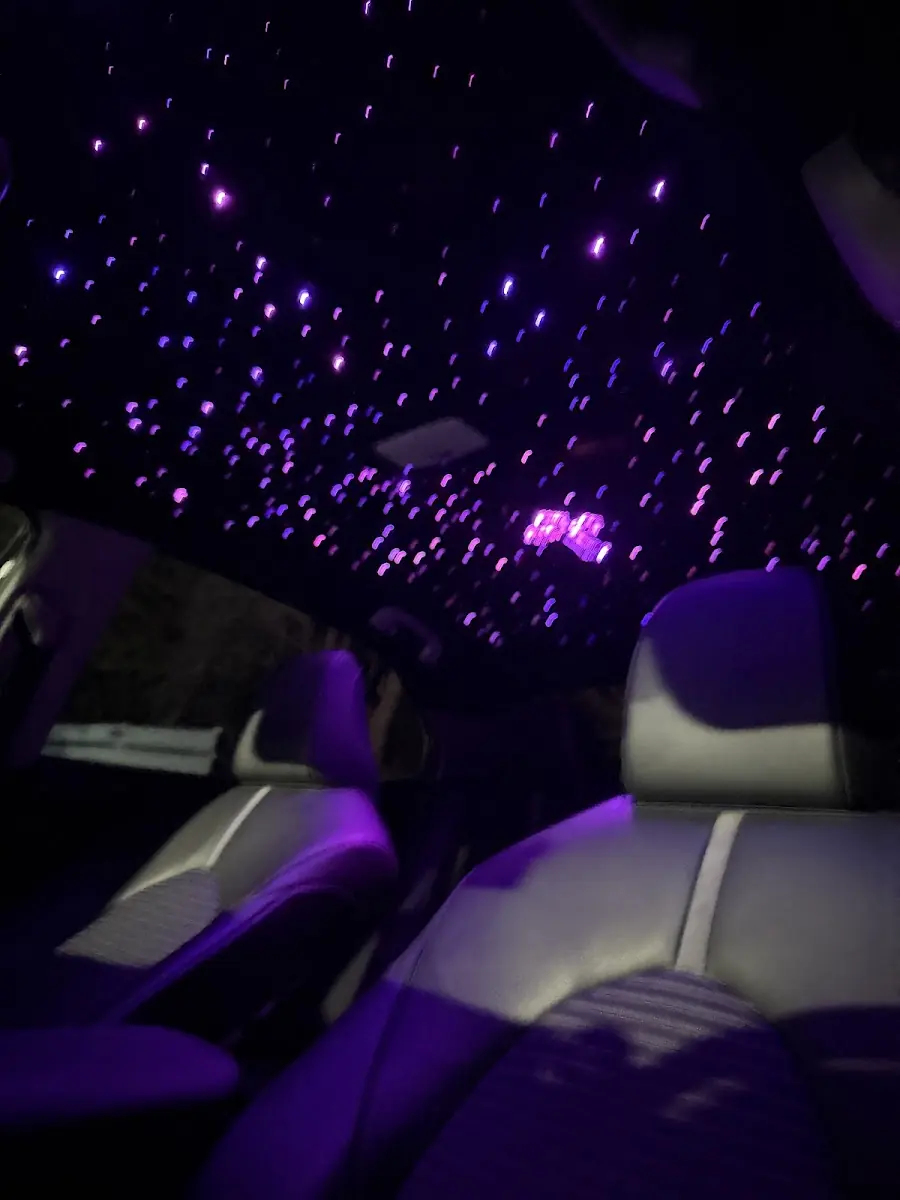
Then the fibers. One at a time, fed from the back, pulled through, glued, left to cure. Hundreds of them. When the adhesive is hard the tips are cut flush and finished. A fiber cut with dull snips throws light sideways and reads as a smudge instead of a point, and that one detail is most of the difference between a ceiling that looks like a sky and one that looks like a kit.

The light engine goes somewhere dry and reachable, behind a trim panel, not buried where the next person has to cut the car apart to change it.

Then the fabric goes back on with adhesive rated for a roof in July. A dark car parked in the sun gets hot enough to soften cheap glue, and cheap glue is why headliners sag. We buy the expensive stuff and let it cure on its own schedule. It is the least interesting part of the job and the part that decides whether the work is still up there in five years. The full build is laid out on our starlight headliner installation page.

The upholstery bench

Leather is the older half of the shop. A hide is not fabric: it stretches more one way than the other, it carries scars and brand marks from an animal that lived a life, and a panel cut without reading the hide first will pull crooked within a season. We cut, skive the wrap edges thin, sew, and fit. Collapsed foam gets rebuilt before anything goes over it, because new leather on dead foam is a wasted hide. That bench is where our custom leather seats and interior rebuilds come from.

The wiring bench

Every circuit we add gets a switched accessory feed, a fused tap, and a loom that can be undone. No vampire taps. Nothing spliced into airbag or safety circuits. The factory harness stays intact so the next owner, or the dealer, can put the car back the way it came. The same rule governs custom headlight and taillight builds and ambient LED lighting as it does stars.

What we turn down

  • Roofs where the shell is already soft with water damage. Fiber will not fix a rotten board, it will only make the real repair cost more later.
  • Lighting that shows red or blue to the front, or flashes. That belongs on an emergency vehicle.
  • Leather over foam that has given up. We rebuild the foam or we pass on the job.
  • Rushing adhesive. The cure takes what it takes, and no deadline changes chemistry.

How we work

Four habits we do not trade away

None of this is a policy document. It is just what the work needs to come out right.

One car in the bay

There is one bay and one bench. The car in the shop is the car being worked on, not the third of five sitting under covers while the fourth gets the attention. It costs us throughput, and it means we sometimes ask you to wait for a slot rather than pretend we can start tomorrow. It is also the only way we know to keep the finish where it is. When your car is in, it is the job.

A number before a screwdriver

We see the car, agree the materials, star count, colour and control, then quote one fixed figure. No hourly clock. No discoveries halfway through.

Reversible where it can be

Switched feeds, fused taps, sleeved looms, factory connectors left alone. Someone should be able to undo our work without reaching for a knife.

Handed back after dark

A starlight ceiling at noon is a grey lid with dots in it. We time the handover for the evening. That is not theatre, it is the only honest way to look at it.

Headliner panel laid flat on the workbench in the Danbury shop See finished starlight builds in the galleryDanbury bench
At the bench

The unglamorous middle of a build

Almost none of a build is the moment the stars come on. It is measuring, marking, gluing, and waiting for glue.

  • Fiber in more than one diameter, so the sky has depth in it instead of a grid of identical dots.
  • Adhesive chosen for the surface it lands on. Headliner board, foam, leather and plastic each want something different, and the wrong one fails quietly months later.
  • Hides picked in person wherever the job allows it. A photograph will not show you grain, scar, or how a piece will stretch.
  • A remote LED engine on a switched circuit, mounted somewhere a hand can actually reach.

The work is slow on purpose. If you want to see how that translates into a build plan and a price, start with the full list of services or send us photos of the car.

Let’s build it

Tell us the car. We’ll tell you what it could be.

Send a couple of photos and the year, make, and model. You get a fixed number back — usually within one business day, always before anything comes apart.

No spam, no reselling your details. We reply to most quotes within one business day.

Call WhatsApp